MS Word Shortcut Keys

Microsoft Word  All Shortcut Keys

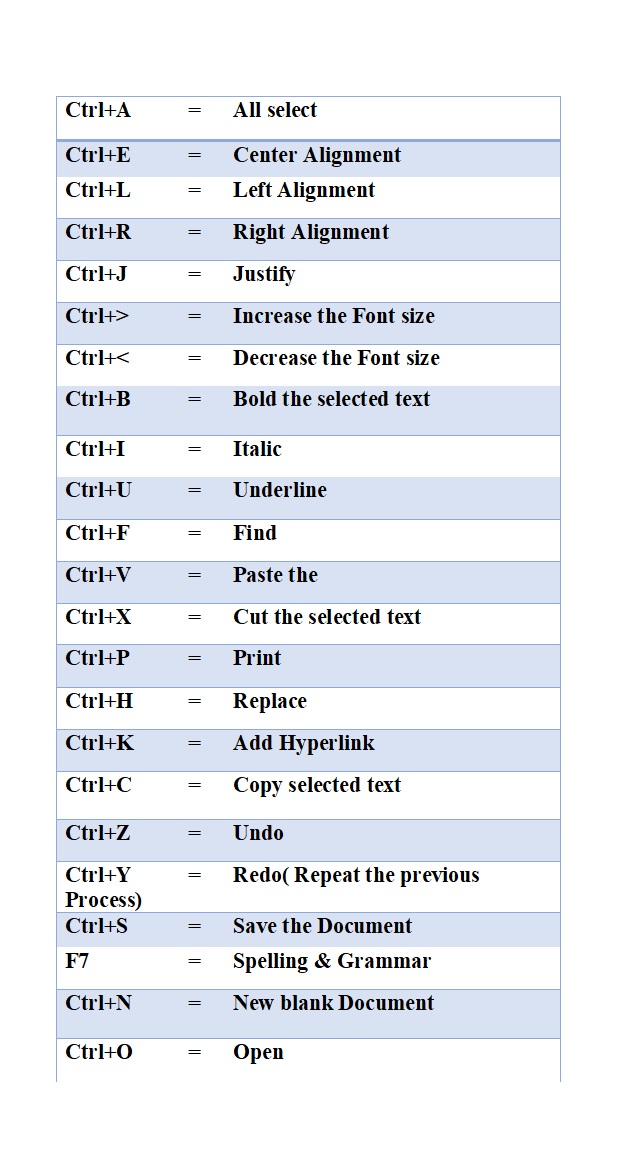
Ctrl+A        =       All select

Ctrl+E        =       Center Alignment

Ctrl+L        =       Left Alignment

Ctrl+R        =       Right Alignment

Ctrl+J        =       Justify 

Ctrl+>        =       Increase the Font size

Ctrl+<        =       Decrease the Font size

Ctrl+B        =       Bold the selected text

Ctrl+I         =       Italic

Ctrl+U        =       Underline

Ctrl+F        =       Find

Ctrl+V        =       Paste the 

Ctrl+X        =       Cut the selected text

Ctrl+P        =       Print


Ctrl+H       =       Replace


Ctrl+K       =       Add Hyperlink


Ctrl+C        =       Copy selected text


Ctrl+Z        =       Undo


Ctrl+Y        =       Redo( Repeat the previous Process)


Ctrl+S        =       Save the Document


F7               =       Spelling & Grammar


Ctrl+N        =       New blank Document


Ctrl+O       =       Open


Ctrl+=        =       Subscript


Ctrl+Shft++=      Superscript


Word shortcut keys Image

Popular posts from this blog

MSCIT Era Session Question answers

 Era Session Answers Era Session 1 Knowledge check A C (read only memory) A (Enter) C (Portable Hotspot)  A  C (trackpad of Laptop)  A (USB dongle)  D (Webcam)  D (Webcam)  C (sign out)  Session Complete Test  C (Computer)  D (you can travel from one location to another)  C (Hardware)  A (Mouse)  A (System Software) Era Session 2 Knowledge Check  B  B  B  B  A  B (Hardware)  C (Operation System)  A (Operating System)  D (Icons, Wallpapers, Task bar)  B (Booting) Session Completion Test  B  C (It is processed to obtain information)  A (True)  A (True)  D (Disk clean up) Era Session 3 Knowledge Check  D  A  D  D  C  A (Fill Fit, Stretch)  C (Slide Show)  B (Screen Saver)  D ( Save)  B Edit Pictures Session Completion Test  B (Program)  D (Operation System)  A (Utilities)  D...

Computer History and Generations

  Computer History Ancient Computers: The most ancient computer was Abacus. It was first automatic computer which was used for the purpose of calculating and counting. Blaise Pascal invented the Pascaline. this device could perform simple addition, subtraction multiplication division. Modern Computers Charles Babbage: On 19th century (1837) English mathematician Charles Babbage created a machine for calculation purpose. He named it as a Analytical Engine.   Charles Babbage considered as " The father of computer/the father of modern day computing" Computer Generations: First Generation Computer (1940-1956) Vaccum tubes  (valves) were used Second Generation Computers: (1956-1963)   Transistors were used More speed as compared to first generation. Third Generation computer (1964-1971) Integrated circuits (IC) were used Speed increased as compared to previous generations. It never became warm. Fourth Generation computers: (1971-1990) Microprocessors ...